
The beauty e-commerce industry is experiencing explosive growth, with the global market expected to surpass $677 billion in 2025. For aspiring entrepreneurs, this represents an unprecedented opportunity, but the path from concept to profitable business can feel overwhelming.
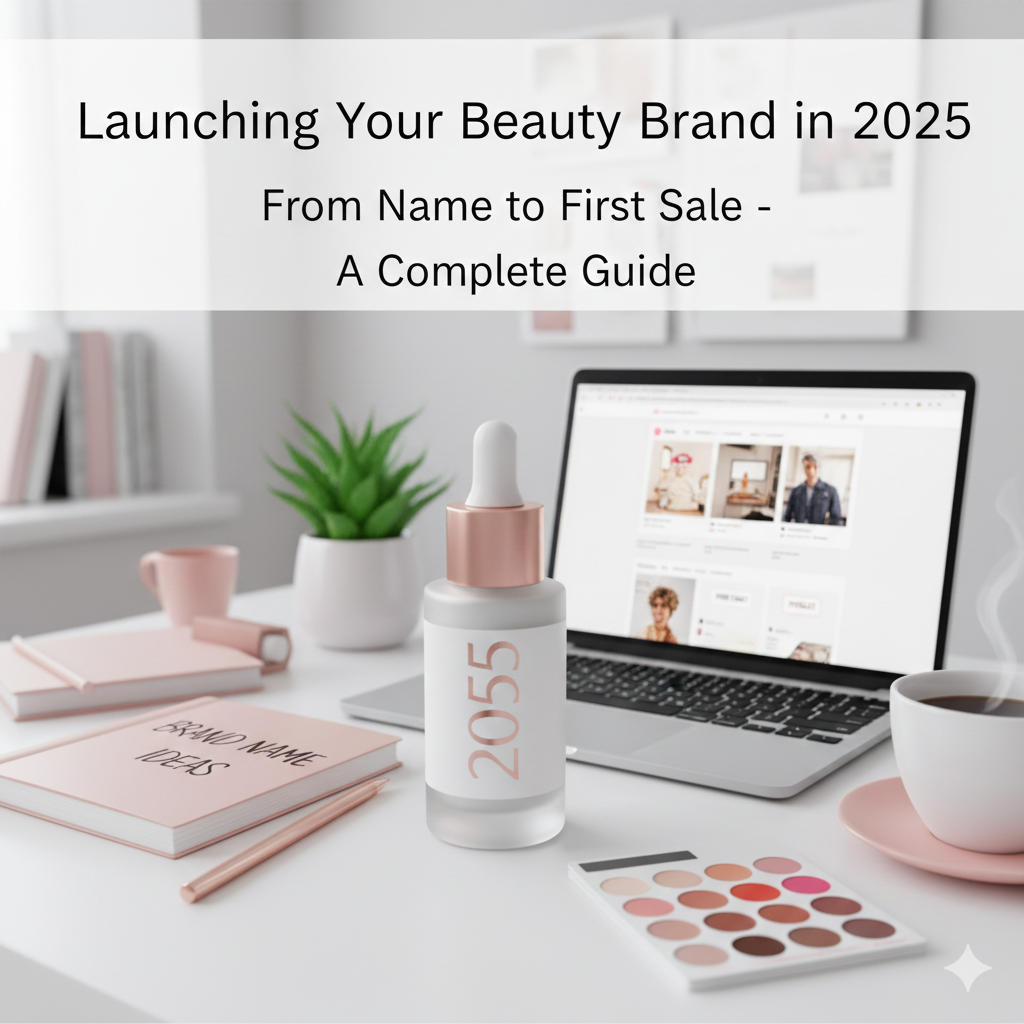
After working with dozens of beauty startups in the Middle East and beyond, I’ve distilled the launch process into a clear roadmap that takes you from zero to your first sales in weeks, not months.
The State of Beauty E-commerce in 2025
Before diving into tactics, let’s understand what you’re entering. The beauty industry has fundamentally transformed. Digital-native brands like Glossier and Fenty Beauty disrupted traditional retail by operating primarily through online channels, proving that you don’t need massive capital or retail relationships to build a successful beauty brand.
Three forces are reshaping the landscape: Generation Alpha and Gen Z now account for 40% of beauty purchases globally, social commerce is projected to hit $80 billion, and the Middle East beauty market is experiencing explosive growth as wealth increases across the Gulf region. This convergence creates a perfect storm of opportunity for new entrants who understand digital-first strategies.
What makes 2025 different from previous years?
Consumers expect personalization at scale, demand sustainable and transparent brands, and make purchasing decisions based on social proof rather than traditional advertising. The barrier to entry has never been lower, but the bar for quality and differentiation has never been higher.
Phase 1: Finding Your Name and Visual Identity
Every successful beauty brand starts with a name that resonates. This is where most founders get paralyzed, spending months debating options with friends and family. Here’s what actually works: spend one focused weekend generating and evaluating options, then commit.
Start by defining your brand’s essence in three words. Is it “luxurious botanical wellness,” or “affordable clinical results,” or “playful Middle Eastern heritage”? These anchors guide your naming process. Then generate 50-100 potential names through various methods: combining relevant words, playing with sounds, exploring other languages, and using modern tools to accelerate the creative process.
The beauty of 2025 is that AI-powered naming tools can help you explore territories you wouldn’t naturally consider. When I was helping a Saudi entrepreneur launch her natural skincare line, we used an AI name generator to explore combinations of Arabic and English roots, ultimately landing on a name that felt authentic to her Riyadh upbringing but accessible to international markets.
Once you have 10-15 strong candidates, the real work begins: validation. This is where many founders make expensive mistakes. That perfect name you love? Seventeen other businesses might already be using variations of it. Before you design labels, register domains, or tell anyone your idea, you need to understand the competitive landscape.
Check domain availability across all relevant extensions, search trademark databases in your target markets, and analyze whether similar names already exist in your category. One founder I worked with fell in love with a name, designed her entire brand identity, and then discovered a European cosmetics company had been using a nearly identical name for five years. She had to scrap everything and start over.
The smartest move? Use tools that help you understand how many businesses use similar names before you get emotionally invested. A quick similarity analysis can save you months of wasted work and potential legal headaches down the line.
Phase 2: Building Your Store Without Breaking the Bank
Once your brand identity is locked, it’s time to build your digital home. Shopify, BigCommerce, and WooCommerce dominate the beauty ecommerce space, each with distinct advantages. For beauty brands specifically, Shopify’s app ecosystem offers unmatched support for the features your customers expect: shade matching, ingredient transparency, subscription models, and augmented reality try-on capabilities.
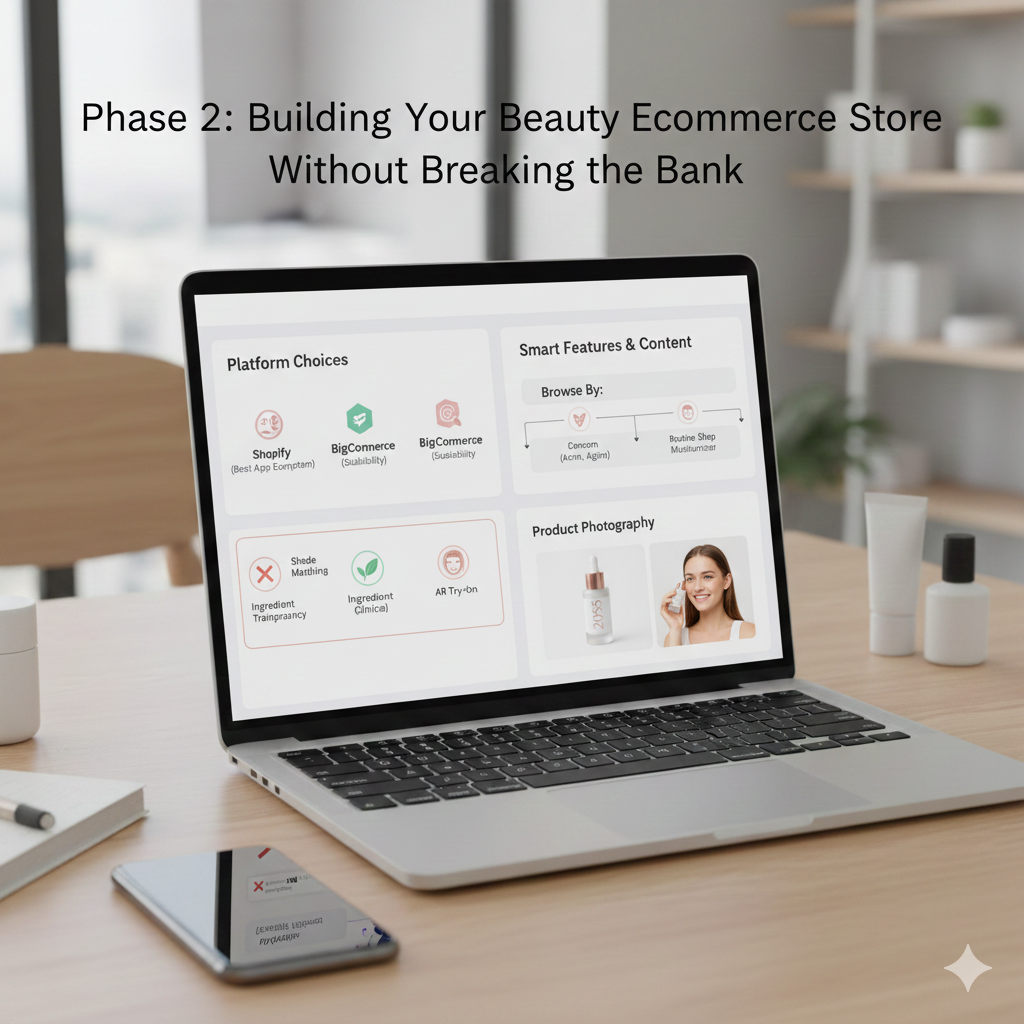
Your store architecture matters more than most founders realize. Beauty consumers navigate differently from other shoppers. They want to browse by concern (acne, aging, pigmentation), by ingredient preference (natural, vegan, clinical), and by routine step (cleanser, serum, moisturizer). Plan your category structure before loading products.
Product photography determines your conversion rate. The data is unambiguous: beauty products with lifestyle imagery alongside clinical shots convert 40-60% higher than those with only packaged product photos. You don’t need a professional studio initially. A smartphone with good natural lighting, a simple backdrop, and models from your target demographic can produce compelling imagery.
Phase 3: Testing Your Concept Before Major Investment
Here’s where most beauty entrepreneurs make their biggest mistake: they manufacture 5,000 units before validating demand. The smarter path? Prove your concept with minimal inventory.
Start with 3-5 products maximum, order small batches (100-200 units), and test market response before scaling. Use Alibaba or local manufacturers for initial runs. Yes, your per-unit cost will be higher, but you’ll learn invaluable lessons about which products resonate, which packaging works, and what messaging converts.
During this testing phase, you’ll need to gather customer emails for launch announcements and feedback requests. Many founders struggle with organizing this initial outreach while protecting their personal inbox from spam. Some entrepreneurs set up temporary contact points for market research and testing campaigns, keeping their primary business email clean for actual customer communications. This separation helps maintain focus during the chaotic pre-launch period.
Create a landing page that captures interest before your official launch. Offer early-bird discounts in exchange for email signups. Use these early supporters as your testing ground: send them product samples, ask for detailed feedback, and refine your formulations based on their input. This approach builds community while minimizing risk.
Phase 4: Your Launch Strategy
The weeks before launch determine your trajectory for the next year. Don’t just “open” your store and hope for sales. Orchestrate a coordinated campaign that creates momentum.
Start with a 30-day pre-launch countdown. Week one: tease your brand story and mission through social media. Week two: reveal your first product with ingredient breakdowns and benefits. Week three: share behind-the-scenes content about your formulation process or manufacturing partners. Week four: exclusive early access for email subscribers.
The economics work beautifully: offer free products plus a small fee ($100-$300) for honest reviews. If they love your products, great. If they don’t, you learn what to improve. Twenty micro-influencer partnerships costing $5,000 total will outperform $5,000 spent on Facebook ads during your launch month.
Social commerce has transformed beauty launches. Set up Instagram Shopping and TikTok Shop before launch day. Gen Z beauty consumers expect to purchase directly within social platforms without visiting external websites. Brands that require multiple clicks to purchase lose 70% of potential customers.
Phase 5: Post-Launch Optimization
Your first month of sales reveals everything you need to know about your business model. Track these metrics obsessively: conversion rate by traffic source, average order value, customer acquisition cost, and repeat purchase rate within 30 days.
Beauty brands live and die by repeat purchases. A customer who only buys once costs you money. A customer who reorders monthly for six months makes you profitable. Structure your pricing and product development around encouraging repeat behavior: subscription options, routine bundles, automatic replenishment reminders.
Email marketing drives 35% of revenue for successful beauty ecommerce brands. Build automated sequences: welcome series for new subscribers, abandoned cart recovery (critical when 22% of beauty shoppers abandon due to complicated checkout), post-purchase education about how to use products effectively, and replenishment reminders based on product usage timelines.
Customer service makes or breaks beauty brands. One bad ingredient reaction handled poorly creates social media backlash that destroys months of brand building. Respond to every inquiry within 4 hours, offer easy returns and exchanges, and proactively address concerns before they escalate.
Phase 6: Scaling What Works
Once you’ve proven product-market fit with your initial offerings, strategic expansion begins. This doesn’t mean launching fifteen new products. It means doubling down on what’s working while methodically testing adjacent opportunities.
Analyze your sales data to identify patterns. Which products have the highest repeat purchase rates? Which traffic sources deliver customers with the best lifetime value? Which marketing messages generate the most engagement? Scale what works, cut what doesn’t.
Consider wholesale opportunities once you’ve proven direct-to-consumer success. Hotels, spas, and boutique retailers constantly seek unique beauty brands to differentiate their offerings. A single hotel chain contract can provide stable, predictable revenue that funds your DTC growth.
Geographic expansion requires careful planning. The Middle East beauty market operates differently than Western markets: different beauty standards, different seasonal demands, different purchasing behaviors. Test new markets small before committing major resources. Run targeted social media campaigns in new cities or countries, measure response, then decide whether full expansion makes sense.
Common Mistakes That Kill Beauty Startups
After watching hundreds of beauty launches, certain failure patterns repeat endlessly. Avoid these and you’ll outlast most competitors.
Mistake one: Perfectionism paralysis. Founders spend eighteen months perfecting formulations, packaging, and branding before launching, only to discover the market wants something completely different. Launch fast, learn fast, iterate fast. Your version 1.0 won’t be perfect, and that’s exactly the point.
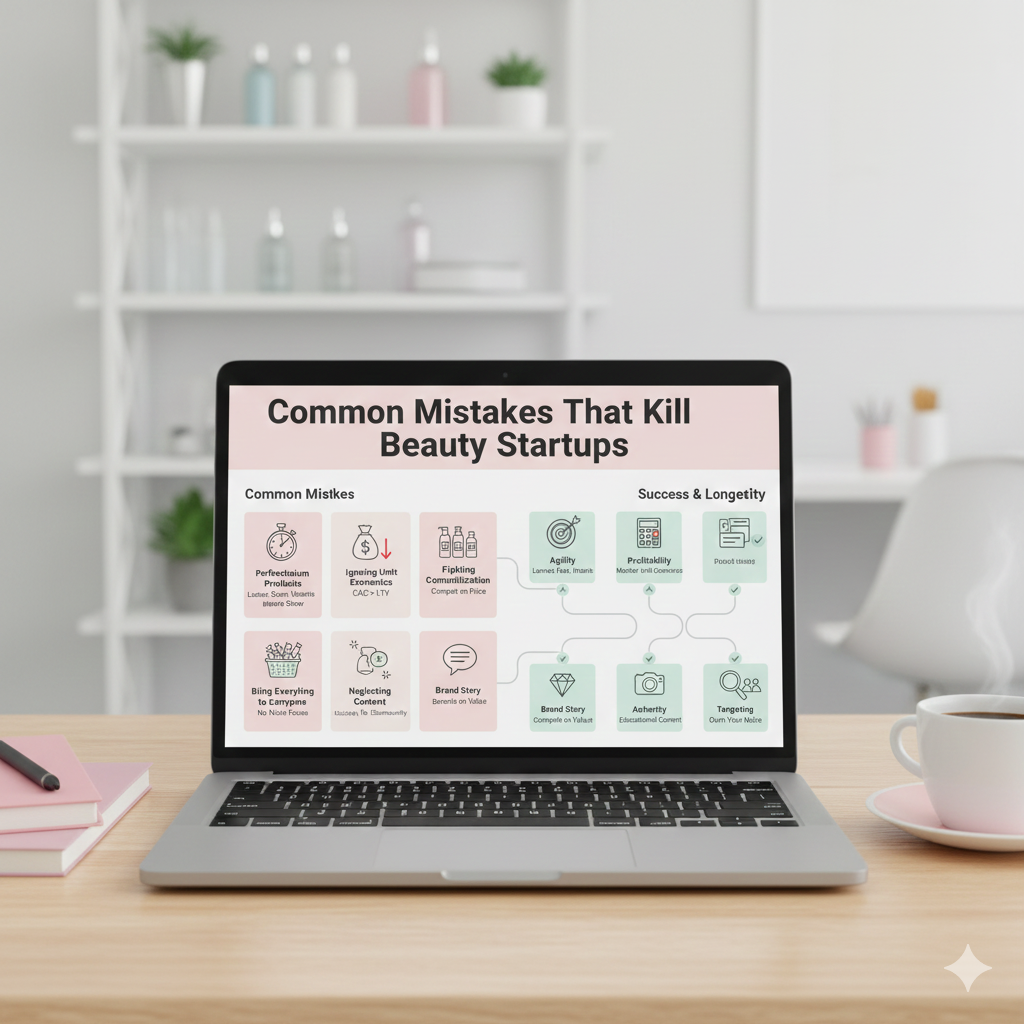
Mistake two: Ignoring unit economics from day one. Revenue feels exciting, but if your customer acquisition cost exceeds customer lifetime value, you’re building a house of cards. Calculate these numbers monthly and adjust strategy accordingly.
Mistake three: Fighting commoditization with lower prices. Beauty is an aspirational category. Consumers associate price with quality. Unless your explicit positioning is “affordable luxury,” don’t compete on price. Compete on story, ingredients, results, and community.
Mistake four: Neglecting content creation. Beauty consumers are researchers. They read ingredient lists, watch tutorial videos, and seek validation from trusted sources. Brands that invest in educational content build authority and organic traffic that compounds over time.
Mistake five: Trying to be everything to everyone. Niche dominance beats broad mediocrity. Better to own the “vegan skincare for Middle Eastern women over 35” category than to be invisible in “general beauty products.” Once you dominate a niche, expansion becomes easier.
The Reality of Building a Beauty Brand
Let’s be honest about what this journey actually looks like. It’s not Instagram-perfect photos and immediate success. It’s late nights figuring out fulfillment logistics, dealing with ingredient suppliers who miss deadlines, handling customer complaints with grace, and questioning whether you should quit your day job.
But here’s what makes beauty ecommerce uniquely rewarding: you’re creating products that make people feel confident and beautiful. That emotional connection creates fierce loyalty and organic word-of-mouth that money can’t buy. When customers tag your brand in their mirror selfies or write unsolicited reviews about how your serum changed their skin, you remember why you started.
The beauty industry in 2025 offers unprecedented opportunity for entrepreneurs willing to think strategically, move quickly, and stay customer-obsessed. You don’t need a six-figure investment or industry connections. You need a clear brand identity, quality products, authentic storytelling, and relentless execution.
The market is crowded, yes, but there’s always room for brands that genuinely solve problems and create community. Your perfect customer is searching for you right now. They’re frustrated with existing options, scrolling through social media looking for something that speaks to them, ready to become your first loyal advocate.
Now stop reading and start building. Your future customers are waiting.
Conclusion: From Idea to Impact—Your Move Starts Now
Building a beauty brand in 2025 isn’t about having the perfect formula, the flashiest packaging, or the biggest budget. It’s about momentum. It’s about getting out of your head and into the market before fear, overthinking, or perfectionism talks you out of the opportunity.
Every phase you’ve just explored—from naming and branding to launch and scale—has one shared truth: clarity beats complexity every time. The founders who win aren’t the ones who know everything. They’re the ones who start before they feel ready, listen obsessively to their customers, and improve faster than everyone else.
Yes, the industry is competitive. But it’s also incomplete. There are still millions of people searching for products that truly work for them, brands that speak their language, and founders who actually understand their problems. That gap is your opportunity.



Comments are closed